Ole Miss vs. Louisville: How to watch, key matchups and what will decide tonight’s opener
The only ranked-versus-ranked game of the opening weekend puts Pete Golding’s first full season against a Louisville team rebuilt almost from scratch — and gives Ole Miss’ new defensive coordinator a night against the program he used to run.
Mississippi Sports | September 6, 2026
Ole Miss opens its season tonight with an immediate test of its top-10 expectations.
The No. 9 Rebels face No. 24 Louisville at Nissan Stadium in Nashville in the inaugural Music City Kickoff, the lone matchup of ranked teams anywhere on the opening weekend. For Ole Miss, the night is a first look at whether an experienced backfield and a heavily reworked supporting cast hold up against outside competition. For Louisville, it is a chance to knock off an SEC contender on a national stage with a roster that turned over almost completely in one offseason.
Preparation in Oxford included a pointed reminder from head coach Pete Golding: talent does not cover a communication mistake.
“There were some explosives in that scrimmage because of lack of communication,” Golding said after Saturday’s mock game. “If you do that this coming Sunday, you’re not going to win the football game.”
That warning frames the central question of the night. Can the Rebels play with the discipline required to keep Louisville from turning an ordinary snap into a game-changing gain?
Where to watch and listen
- Matchup: No. 9 Ole Miss (0-0) vs. No. 24 Louisville (0-0)
- Date: Sunday, September 6, 2026
- Kickoff: 6:30 p.m. Central / 7:30 p.m. Eastern
- Location: Nissan Stadium, Nashville, Tennessee (capacity 69,143)
- Television: ABC — Sean McDonough (play-by-play), Greg McElroy (analyst), Katie George (sideline)
- Streaming: ESPN App; check your subscription or provider access before kickoff
- Ole Miss radio: Ole Miss Radio Network — David Kellum, Harry Harrison, John Darnell
- Louisville radio: 93.9 The Ville and 970 WGTK — Paul Rogers, Craig Swabek, Jody Demling
- National radio: ESPN Radio
- Fan color: Powder blue
Two programs arriving from very different places
Golding enters his first full season after being named the 40th head coach in Ole Miss history on Nov. 30, 2025, then going 2-1 in a College Football Playoff run that reached the semifinals. The Rebels finished 13-2, the first 13-win season in program history, and closed at No. 3 in the AP poll.
They begin this year ninth in the AP poll and 10th in the Coaches poll — their highest preseason AP ranking since entering 2016 at No. 10, and part of a stretch in which Ole Miss has cracked the national top 10 in each of the last six seasons, its longest such run since 1959-64.
Louisville arrives on a quieter but steadier trajectory. Jeff Brohm is in his fourth season at his alma mater with a 28-12 record there and 94-56 across 13 years as a head coach. The Cardinals have won at least nine games in each of his three seasons, going 9-4 (4-4 ACC) last year with a 24-21 win at No. 2 Miami — their first road victory ever over an AP top-10 team — before a 41-0 shutout of Kentucky and a 27-22 win over Toledo in the Boca Raton Bowl. Louisville is 24th in the AP poll, its first preseason ranking since 2017, and was picked third in the ACC’s preseason media poll.
Brohm’s teams are 2-2 against top-10 opponents at Louisville and 8-4 in season openers overall, including 3-0 with the Cardinals. Ole Miss is 97-29-5 all-time in openers and has won its last five, scoring 40 or more in each of the last three.
Familiar faces on the other sideline
This is only the second meeting between the programs, but the rosters and staffs are tangled together.
Ole Miss’ new defensive coordinator, Bryan Brown, spent four seasons in that same job at Louisville from 2019-22. His 2022 Cardinals led the FBS in sacks while ranking inside the national top 15 in takeaways, tackles for loss, scoring defense and interceptions. Tonight he calls a defense against the program where he made his name.
Louisville defensive back T.J. Banks spent 2024 and 2025 at Ole Miss, playing 23 games in Oxford before transferring. Rebels assistant pass game coordinator Patrick Carter caught 31 passes for the Cardinals in 2006 and 2007. And Louisville tight end Justyn Reid has already faced these Rebels in a big moment — he caught a 29-yard touchdown for Tulane in Ole Miss’ first-round College Football Playoff win last December.
Brohm has never coached against Ole Miss. He is 6-6 against the SEC in his career.
When Ole Miss has the ball: Chambliss against Louisville’s edge
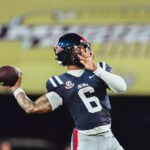
Quarterback Trinidad Chambliss is the Rebels’ most valuable asset. He threw for 3,937 yards and 22 touchdowns against three interceptions last season while adding 527 rushing yards and eight scores, and he did it without giving the ball away — his 173 consecutive attempts without an interception rank second in program history. He is on the Maxwell, Walter Camp, Davey O’Brien and Manning award watch lists and came in fifth in ESPN’s preseason top 100.
Louisville defensive end Clev Lubin is the direct challenge to that efficiency. Lubin posted 61 tackles, 13.5 tackles for loss, 8.5 sacks and three forced fumbles in his first season with the Cardinals after transferring from Coastal Carolina, and Pro Football Focus graded him the top returning edge rusher in the ACC at 91.4. He is a preseason All-ACC pick and appears on the Bednarik, Nagurski and Lott IMPACT watch lists.
He is not alone. AJ Green returns opposite him with 4.0 sacks, and North Carolina transfer Tyler Thompson arrives off a 7.0-sack junior season. All three rank among the eight highest-graded returning edge rushers in the conference.
Golding named that group as his primary concern for the Ole Miss offense, along with a Louisville secondary that led the ACC in both passing yards allowed (188.8 per game) and pass efficiency defense a year ago.
The counterweight: Ole Miss allowed 1.27 sacks per game in 2025, best in the SEC and 17th nationally, and gave up only 4.67 tackles for loss per game. Three starters return up front in Patrick Kutas, Brycen Sanders and Delano Townsend. Whether that number holds against this particular edge group is the most direct collision on the field.
The receiver room is brand new
The complication for Ole Miss is who Chambliss is throwing to. The Rebels lost their top targets from a passing game that averaged 313.3 yards per game, third in the FBS.
Deuce Alexander is the lone primary returning receiver after 44 catches for 684 yards, including an 88-yard touchdown against Mississippi State. Around him are transfers Johntay Cook II, who led Syracuse with 45 catches for 549 yards, and Horatio Fields, who had 39 receptions for 463 yards at Wake Forest in 2024. Caleb Odom returns with 19 catches.
Chambliss spoke warmly about the group during game week. “They always ask me, how can I help you being the quarterback and them being the receiver,” he said. “They’re very eager to learn.” Tonight is the first outside evidence of whether that chemistry is real, and it comes against the ACC’s stingiest pass defense from a season ago.
Kewan Lacy against a rebuilt Louisville front
Running back Kewan Lacy is the other half of the Rebels’ proven backfield, and his 2025 rewrote the record book: 306 carries, 1,567 rushing yards and 24 rushing touchdowns, all single-season program records. He led the FBS in carries and finished top three nationally in rushing yards, rushing touchdowns and total points scored, earning first-team All-America honors from the FWAA and Phil Steele and becoming the first Rebel named a Doak Walker Award finalist.
Consistent gains would let Ole Miss control its play selection, create friendlier third downs and force Louisville to account for the run before attacking Chambliss. Near the goal line, finishing drives on the ground is the difference between touchdowns and field goals.
Louisville’s front held up well last season, allowing 114.3 rushing yards per game, 23rd nationally. But the personnel around it has changed. The Cardinals return four defensive starters and brought in 34 transfers overall, the second-ranked haul in the On3 Transfer Portal Index.
Watch where first contact happens on Lacy’s carries. Repeated contact in the backfield signals trouble for the Rebels’ blocking. Contact several yards downfield means Ole Miss is getting the game it wants.
When Louisville has the ball: an unknown at quarterback, a known problem at running back
Ohio State transfer Lincoln Kienholz is Louisville’s projected starter, and he is a genuine unknown. Brohm has started a different portal quarterback in each of his three seasons at Louisville — Jack Plummer, Tyler Shough and Miller Moss — and each arrived with thousands of career passing yards, then produced the best season of his career as a Cardinal. Kienholz arrives with 250 passing yards and one touchdown across 12 games as an Ohio State backup.
That puts unusual weight on the running game, and Louisville has the personnel for it.
Isaac Brown is the most explosive player on the field tonight. He rushed for 884 yards and seven touchdowns in just nine games last season at 8.8 yards per carry — a mark that would have led the country by more than a yard had he carried often enough to qualify. He missed the final four regular-season games with an injury, returned for 102 yards and two scores in the bowl, and still made third-team All-ACC. Against Boston College he ran for a career-high 205 yards on 14 attempts.
The explosiveness is not a one-year fluke. Over two seasons Brown has 2,057 yards and 18 touchdowns in 22 games at 7.7 yards per carry, with 21 percent of his career runs going for 10-plus yards. Even in nine games last year, he led all FBS players with six rushes of 50 yards or more.
Senior Keyjuan Brown makes it a pair. He added 704 yards at 7.3 per carry, third nationally among backs with at least 90 attempts. The two combined for 1,588 yards and 13 touchdowns despite missing seven games between them.
Golding did not hedge in describing the challenge. “I think he’s one of the best backs we’ll see all year when you really watch him on tape,” he said of Isaac Brown. “Really good in space. He’s got top-end speed to be able to finish.”
Louisville’s offensive line, though, is almost entirely new. Only Lance Robinson returns from the 2025 rotation. Five transfers — from Georgia Southern, Boston College, South Carolina, Delaware and Kentucky — bring a combined 156 games and 79 starts, but they have not played a live snap together.
The Ole Miss front seven, and a new linebacker
The Rebels have answers up front. Defensive tackle Will Echoles returns after 68 tackles, 11.5 tackles for loss and five sacks, a season in which Pro Football Focus credited him with leading all Power Four defensive linemen in both pressures (39) and defensive stops (35). He was Sugar Bowl Defensive MVP in the win over Georgia.
Suntarine Perkins, this year’s Chucky Mullins Courage Award winner, returns after 81 tackles, 12.5 tackles for loss and 4.5 sacks. Kam Franklin adds 9.0 tackles for loss.
The newcomer to watch is linebacker Keaton Thomas, who arrives from Baylor having started all 25 games over the past two seasons with 219 tackles, 14.0 tackles for loss, two interceptions and two defensive touchdowns. He was first-team All-Big 12 in 2024 and had 103 tackles last season. He is on the Butkus and Bednarik watch lists and takes over for TJ Dottery, the Rebels’ leading tackler a year ago. Cal transfer Luke Ferrelli, the 2025 ACC Defensive Rookie of the Year with 91 tackles, joins him in the room.
Against Brown, none of that matters as much as gap discipline. One defender in the wrong lane gives him the field before the secondary can react.
Tre Richardson and the space behind the run fits
The reason Ole Miss cannot simply crowd the box is Tre Richardson.
The Vanderbilt transfer caught 46 passes for 806 yards and seven touchdowns last season, averaging 17.5 yards per reception — fifth in the SEC — and led the Commodores in receiving yards and receiving touchdowns. He saved his best for last, piling up 485 yards and six scores over the final four games. He is on the Biletnikoff and Paul Hornung watch lists and was Vanderbilt’s kick returner, adding 427 yards on 17 returns.
Louisville added Florida State transfer Lawayne McCoy (27 catches, 396 yards) alongside him, plus a reshaped tight end room led by Mackey Award watch list member Brody Foley, who had 37 catches for 528 yards and nine touchdowns at Tulsa.
Safety Sharif Denson, who transferred from Florida, said the Rebels’ secondary came together quickly in camp. “I would say we have great chemistry at the moment and we just continue to build it day by day,” he said. Tonight tests whether that familiarity survives formation changes and pre-snap motion.
The numbers that frame it
Last season’s statistics point at two clear pressure points.
Louisville converted just 35.5 percent of its third downs, 102nd nationally, while fielding a defense that ranked 16th in the FBS in total yards allowed and second in the ACC. Ole Miss was close to the mirror image: second nationally in total offense at 489.7 yards per game and first in the FBS in first downs with 383, paired with a defense that ranked 48th in total yards allowed.
The Cardinals’ path, in other words, is to keep this low-scoring and win on defense. The Rebels’ path is to make it a track meet. Louisville averaged 29.9 points a game last year. Ole Miss averaged 36.9.
Special teams tilt toward Oxford. Kicker Lucas Carneiro made 31 of 35 field goals with a program-record five from 50-plus yards and a career-long 58 against Miami, and punter Oscar Bird averaged 46.0 yards as the Rebels finished third nationally in net punting at 43.61. Louisville ranked 113th in net punting and has lost the return man who drove its ninth-ranked punt return average.
What will decide the game
Golding framed it plainly this week.
“This to me is an SEC game,” he said. “You got to run the football, stop the run, take care of the football, and win the turnover battle or you’re not going to like the outcome.”
Three things follow.
First-down efficiency. Both offenses get much harder to defend when their backs create manageable second and third downs. Given Louisville’s third-down struggles a year ago and the inexperience at quarterback, negative early-down plays are close to fatal for the Cardinals.
Explosive plays. Ole Miss has to contain Brown without losing track of Richardson behind it. Louisville has to keep Lacy’s rushing threat from opening easy throws for Chambliss — against a receiver group still proving itself.
Possession-changing mistakes. Lubin’s knack for forcing fumbles makes ball security in the pocket especially relevant, and Chambliss’ three-interception season is the counterargument. At the other end, Ole Miss should make a first-time starter earn his completions rather than hand him early confidence.
The programs have met only once, a 43-24 Ole Miss win in the 2021 Chick-fil-A Kickoff in Atlanta, a game the Rebels led 26-0 at halftime. Nothing about tonight resembles it. Ole Miss brings 59 newcomers, including 33 transfers from the nation’s No. 2-ranked portal class. Louisville brings 34 transfers of its own and a quarterback nobody has scouted as a starter.
The Rebels proved last season they could survive close games, winning six of eight decided by one score. By the end of the night in Nashville, they will have their first real answer about whether the version of this team that shows up in September is built the same way.